

Featured products
-
Omveo One - Fall Detection Smartwatch
Regular price $197.00 USDRegular price$249.00 USDSale price $197.00 USDSale

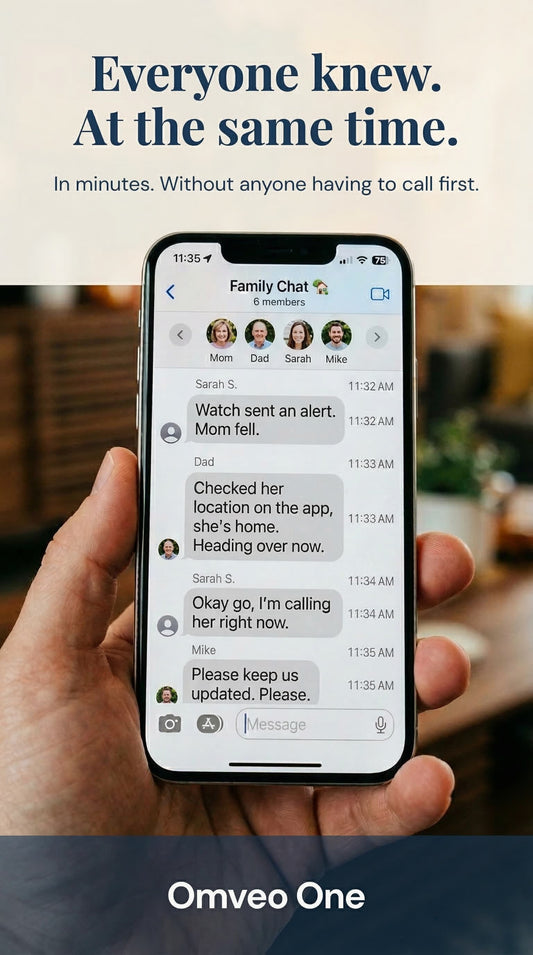
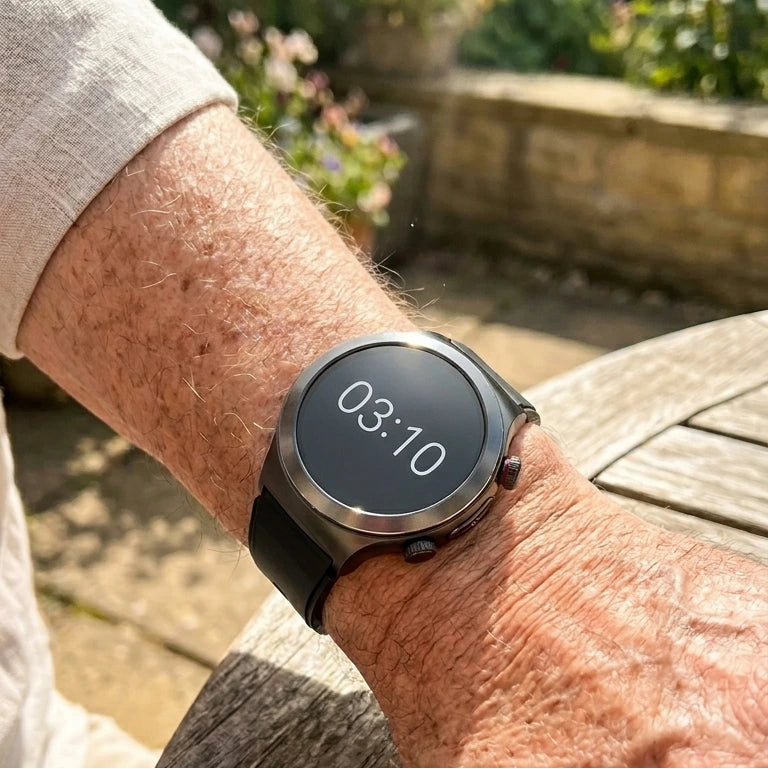
We Built Omveo One Because the Button Doesn't Work.
Every product has a moment of origin. For Omveo One, that moment wasn't in a design studio or a funding meeting. It was at 2:47 in the morning, in a conversation that started with a missed call. A daughter — let's call her Sarah — checked her phone and saw six unanswered calls from her mother's number. The timestamps told a story no one wants to read: 11:04 PM. 11:22 PM. 11:39 PM. Midnight. 12:18 AM. 2:31 AM. Her mother had fallen in the hallway. She'd been wearing her medical alert pendant — the one Sarah had spent weeks researching and $90 a month to keep active. But in the chaos of the fall, she couldn't reach it. She lay there for over three hours before a neighbor happened to notice the lights on at an unusual hour. She survived. But that night changed everything for the people who built Omveo. The Problem No One Was Solving Here is a statistic that stopped us cold: 80% of older adults who fall do not press the emergency button. Not because it wasn't there. Not because they forgot. But because the button requires something most proud, independent people simply cannot do in a crisis: ask for help. 80% of fall victims don't press the traditional alert button PMC Review / Fleming, BMJ 1 in 4 adults 65+ fall every single year in the US CDC, 2023 Every 19 min an older American dies from a fall-related injury NCOA, 2025 The industry had been building better buttons for decades. We decided to build something different: a watch that doesn't need the person to do anything. A watch that looks like a watch — that tells time, tracks steps, monitors heart rhythm — and silently, automatically detects a fall and alerts the right people. No button. No stigma. No monthly fee. What We Actually Believe We believe your parent deserves to age on their own terms. We believe you deserve to sleep through the night. And we believe those two things are not in conflict — they just require the right technology. Omveo One isn't marketed as a "medical device." It doesn't look like one. It's a thoughtfully designed smartwatch with ECG monitoring, GPS, heart rate tracking, and automatic fall detection — that your parent will actually want to wear every day. That last sentence is the most important one on this page. Our Promise Is Simple One-time purchase. No monthly monitoring subscription. No three-year contract. No activation fee. If something happens, you're notified instantly — not when the morning shift checks in, not when the cleaning lady arrives on Monday. Instantly. "The goal isn't to monitor your parent. It's to give them back their independence — and give you back your peace of mind." — The Omveo One Team We're a team of engineers, caregivers, and adult children who have lived this exact situation. We built the product we wish we'd had. We hope it changes things for your family the way we believe it could have changed things for Sarah's. Meet Omveo One Automatic fall detection. ECG monitoring. GPS tracking. One-time payment. No monthly fee. Learn More Starting at $197 — once. That's it.
Read More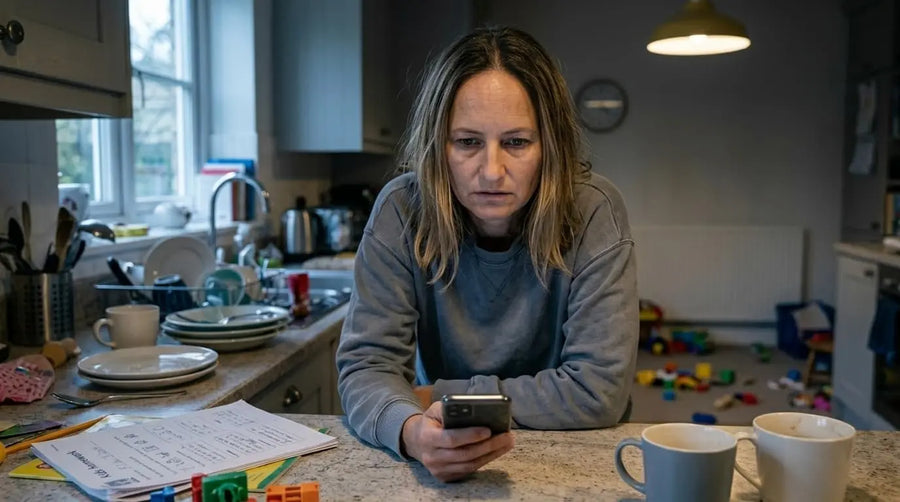
The Sandwich Generation: Squeezed from Every Direction
If you're reading this, there's a good chance you know exactly what it feels like to hang up the phone with your mom, take a breath, then immediately get called into a meeting. Or to be at your daughter's school play — really, genuinely present — while a corner of your brain is already running the math on whether your dad remembered to eat today. You are not alone. You are part of the Sandwich Generation: adults who are simultaneously raising children and caring for aging parents. And the numbers describing your situation are staggering. The Numbers Behind the Exhaustion 59M Americans are in the Sandwich Generation Pew Research, 2022 27 hrs/wk Average time spent on caregiving each week AARP & NAC, 2025 $7,242 Average out-of-pocket caregiving costs per year AARP, 2021 Twenty-seven hours a week. That's a part-time job — unpaid, emotionally taxing, with no clear job description and no one to cover your shifts. One in four of those caregivers is spending 40+ hours per week on care. That's full-time. The Emotional Weight No One Talks About The data captures the time and money. It doesn't quite capture the feeling. The low-level, background hum of worry that never fully turns off. The guilt that trails you when you choose your own child's birthday party over driving two hours to check on your mom. The strange grief of watching a parent who once seemed invincible become someone who needs help with things they used to do effortlessly. "I checked my phone 14 times during my son's soccer game last Saturday. Not because anything was wrong. Just because... what if something was?" — Caregiver community forum, AgingCare.com Research from Carnegie Mellon University found that 54% of American adults worry about a parent falling. Of those, 70% experience that worry weekly or every single day. Even people whose parents are already in assisted living — surrounded by professional care — worry at the same rate. That worry doesn't go away just because the risk is managed. It becomes background noise. Chronic, low-grade anxiety that silently shapes every decision. The Invisible Burnout Here is something the caregiving research makes painfully clear: most people doing this work don't call themselves caregivers. They say they're "just doing what anyone would do." They say they're fine. And then 76% of them report experiencing burnout. 76% of family caregivers report experiencing burnout A Place for Mom, 2025 67% struggle to balance work and caregiving AARP, 2024 50% experience sleep problems weekly due to worry A Place for Mom, 2025 What You're Actually Looking For When we talk to people in this situation, they don't say they want a gadget. What they describe, almost universally, is wanting permission. The psychological permission to put the phone down. To be fully present at dinner. To sleep without waiting for it to ring. What they want — in the word they almost always use — is peace of mind. Not surveillance. Not control. Just the knowledge that if something happens, they will know. Immediately. Not hours later. The hardest part 75% of families only purchase a fall detection solution after a fall has already happened. The goal of Omveo One is to be there before that moment — not after it. Omveo One was designed with this family in mind. Not as a medical device that broadcasts vulnerability, but as a smartwatch that provides quiet, automatic protection — so that everyone, parents and adult children alike, can exhale a little. You didn't sign up for 27 hours a week of this. But you're doing it anyway, because that's who you are. We built something to make it a little easier. Less worry. More presence. Omveo One alerts you automatically if your parent falls — no button required. One-time payment, no subscription. Explore Omveo One
Read More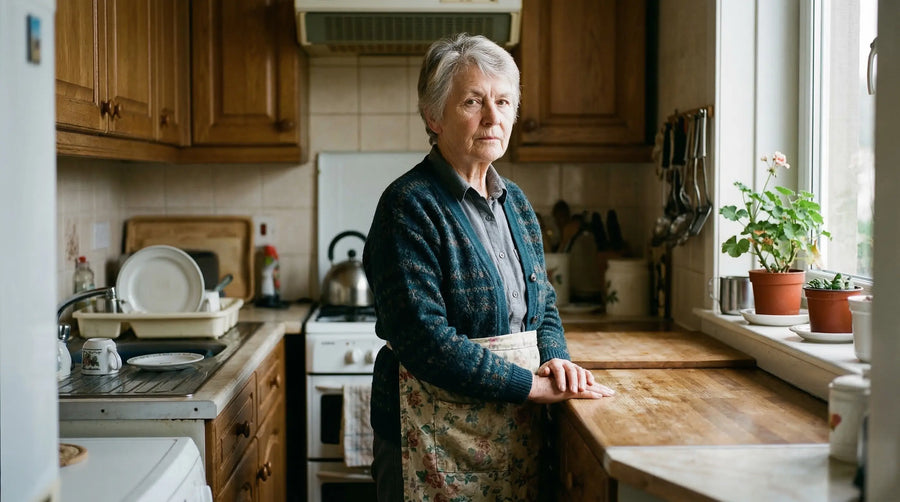
The Fall Your Parent Didn't Tell You About
There's a conversation happening in millions of American homes — or rather, not happening. An older adult takes a tumble. Catches themselves on the counter. Goes down in the hallway. Gets up, dusts off, doesn't tell anyone. Not the doctor. Not the children. Not anyone. 1 in 5 adults over 65 who fall do not report it to their physician. The CDC calls this a "silent crisis." After spending time in caregiver communities, we'd call it something else: completely understandable, deeply human, and terrifying in its consequences. The Scale of the Problem 1 in 4 adults 65+ fall every year — 14 million people CDC, 2023 3 Million emergency room visits per year due to falls CDC, 2026 41,000+ adults died from falls in 2023. Preventable deaths. CDC, 2025 One fall every year for one in four people over 65. Three million emergency room visits. And behind each of those statistics is a family — often learning about it too late, often wishing they had known sooner. Where Falls Happen 80% of fall-related emergency department visits happen at home. Not on icy sidewalks. Not in parking lots. At home — in the bathroom, the hallway, the kitchen — in the middle of the night when no one is watching. That's also where the fall detection devices are usually not being worn. Left on the charger. Sitting on the nightstand. Tucked away because they're uncomfortable to sleep in. The "Long Lie" — The Data Point That Changes Everything In gerontology, there's a term for what happens when someone falls and can't get up for an extended period: the long lie. It sounds clinical. The reality is not. Critical finding Among adults who fall and remain on the floor for one hour or more, 50% die within six months — even when the fall itself causes no direct injury. The time spent waiting is the danger. (Vellas et al., Age & Ageing, 1997) 30% of adults over 90 who fall remain on the floor for more than an hour. 88% of falls in that age group happen when the person is alone. Two hours on a cold floor is not just uncomfortable. It raises the risk of dehydration, hypothermia, kidney failure, and pneumonia — regardless of whether the fall itself caused any broken bones. "If I hadn't been there to call paramedics, she could have been on the bedroom floor for 36 hours until the cleaner arrived Monday afternoon." — Diana Nevins, pathologist and long-distance caregiver The Hip Fracture Pipeline 319,000 older adults hospitalized for hip fractures annually CDC, 2026 1 in 4 die within one year of a hip fracture Systematic Review, 2019 10.2× increased risk of nursing home admission after serious injury Tinetti et al., NEJM, 1997 40% of nursing home admissions are triggered by falls. More than half of hip fracture patients are discharged not to their homes, but to care facilities. What This Means for Your Parent The research is clear on one intervention that dramatically changes outcomes: fast response time. When a fall is detected and help arrives quickly, complications from the long lie are largely prevented. Recovery is faster. The pipeline to the nursing home is interrupted. Fast response changes everything. Omveo One detects falls automatically and alerts you instantly — no button required, no monthly fee. See How It Works One payment. Lifelong peace of mind.
Read More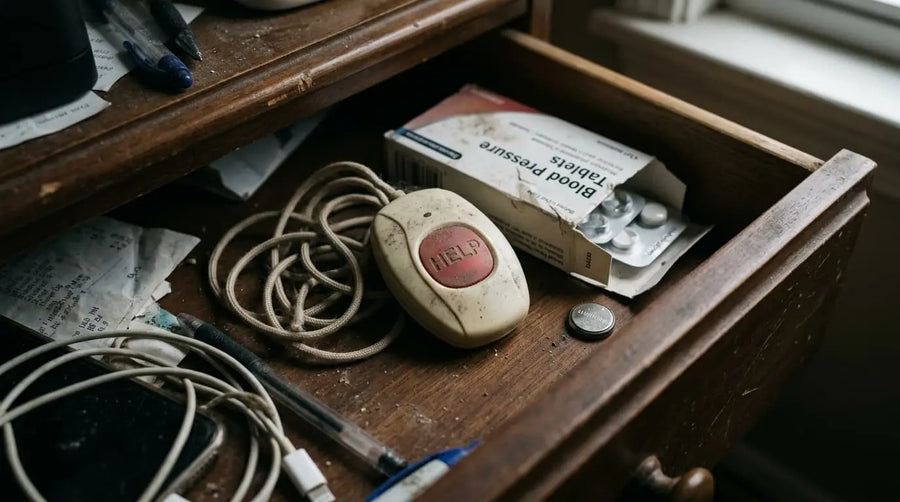
Why Your Parent Won't Press the Button — And What to Do About It
The research is unambiguous, and if you've spent any time in caregiver forums, you already know it from experience: the traditional medical alert system has a fundamental flaw that no amount of better design or lower pricing can fix. It requires your parent to press a button. And in study after study, in real-world observation after real-world observation, the people who need to press it — don't. The 80% Problem 80% of older adults who fall do not use their traditional alert device PMC Review / Fleming, BMJ 10% of Americans 65+ actually use a medical alert system The Senior List, 2023–2024 In a landmark study of adults over 95 who had fallen while carrying a call alarm, 80% did not use the alarm. Researchers asked them why. The answers are worth reading carefully: "I wanted to get up by myself. It took a long time but I managed. I don't like having to ask for help." — Study participant, 95+ age group "I didn't want to use the call alarm because I was afraid they'd take me to hospital." — Study participant, 95+ age group This isn't stubbornness. This isn't a design problem. This is deeply human. Independence is central to identity. Why Traditional Systems Fail in Practice The Problem What Families Experience Stigma "It makes me look old. I won't wear it." Left charging "She fell. The pendant was on the charger." Requires button press 80% don't press it — even after falling Slow/soft falls missed Most elderly falls are gradual slides, not sudden drops High cost Life Alert: $2,700+ over a 3-year contract Real scenario from a caregiver forum "She fell and was on the floor for 12+ hours. The pendant was on the charger. So it was completely useless." The Smartwatch Shift Why will they wear an Apple Watch but not a pendant? Because it doesn't announce what it is. It looks like something a person who has their life together would wear. "My dad said he fell — face down on the floor, bruised — and still said he didn't fall. Because to him, admitting it meant giving something up." — AgingCare.com community member The Conversation That Actually Works "This could help you stay in your home longer." Independence is the goal. "I need this for my peace of mind — it's actually for me." Shifts the frame from them to you. "It means I don't have to call you six times a day." Practical and honest. No button. No monthly fee. No compromise. Omveo One automatically detects falls and alerts your family — because 80% of people won't press the button. Get Omveo One $197, one-time payment.
Read More